
All about improving the customer experience for older consumers
Saturday, December 31, 2011
My favourite things - 40 years on
To commemorate Julie Andrew's birthday she made a special appearance at Manhattan 's Radio City Music Hall for the benefit of the AARP. A friend of mine was good mates with the guy who produced the show. These are the words that she used - I found them amusing.
The video was produced in 2010 and contains the same lyrics. Something to bring a smile to your face as we enter 2012.
Botox and nose drops and needles for knitting,
Walkers and handrails and new dental fittings,
Bundles of magazines tied up in string,
These are a few of my favorite things.
Cadillacs,cataracts, hearing aids, glasses,
Polident, Fixodent and false teeth in glasses,
Pacemakers, golf carts and porches with swings,
These are a few of my favorite things.
When the pipes leak,
When the bones creak,
When the knees go bad,
I simply remember my favorite things,
And then I don't feel so bad.
Hot tea and crumpets and corn pads for bunions,
No spicy hot food or food cooked with onions,
Bathrobes and heating pads and hot meals they bring,
These are a few of my favorite things.
Back pain, confused brains and no need for sinnin',
Thin bones and fractures and hair that is thinnin',
And we won't mention our short shrunken frames, When we remember our
favorite things.
When the joints ache,
When the hips break,
When the eyes grow dim,
Then I remember the great life I've had,
And then I don't feel so bad.
Last post of 2011 - very best wishes for 2012. Dick Stroud

Friday, December 30, 2011
Why making 2012 forecasts is a waste of time
As we approach the New Year we all try and forecast what will happen in the coming 12 months to both our social and professional lives.
Most of the time this activity is no more than daydreaming about our hopes and desires rather than formulating rationale predictions. Some may attempt to predict how the events that were shaping the world on the 31st December 2011 will play out by 31st December 2012. However rigorous the process the outcome is unlikely to worth the effort.
With the exception of cataclysmic convulsions of nature the events that are shaping the future are obvious. What is impossible to know is the timing of when a nuisance grows to an annoyance that becomes a problem that morphs into danger that ends becoming a catastrophe. Add to this an inability to know (or a willingness to recognise) if we are reacting to the manifestation of an event or its fundamental causes.
Let me give you a couple of examples. Today’s newspapers reveal that in 1981 the Government debated/discussed the “managed decline” of the North of England. The argument was that instead of spending public funds ‘invigorating’ Merseyside it would have been best to accept the fact that the city was in terminal decline and make that process as painless as possible. For Liverpool read the other large Northern towns. Even to Mrs. Thatcher this latter option was not palatable.
The policy then, as is now, has been to reshape the North of England. For periods the figures suggested this was happening. A bucket load of money was spent on Liverpool. There were a few good years in the sun but the population has halved and it bounces along the bottom in a downward direction. The policies to ‘invigorate’ have failed and still nobody can even mention the option of “managed decline”.
Another example is the Euro. In today’s Lex Column of the FT he argues that we have spent the last few years mucking about trying to cure the symptoms but ignoring the underlying problem. The Euro will fail, or certainly not look anything like it does at the moment, of this I am certain. What I have no idea about is when the demise will occur. By continuing to focus policy on the symptoms the currency might go on for years or days. Like the North of England, the European politicians cannot face the solution of “managed decline” and keep looking for the magic bullet to cure the symptoms.
So what does all of this mean to us marketers?
I suggest you make a list that has two columns. In column one you list the things you know will happen – be really, really, honest about what you write. In the other column detail your ability to predict the timing and the magnitude – be really, really, honest about what you write.
Let me start you off with a suggestion.
Young people (18-24) will suffer an accelerating decline in their disposable expenditure for at least the next 24 months. So do you face this fact and propose policies equivalent to the “managed decline” or do you try and ‘invigorate’ the market? You might be able to delay the event (at a cost) but you will not be able to change the eventual outcome.
So your choice. Do you make 2012 the year you are really honest about what is really happening and your lack of ability to predict the outcomes or will it be “service as normal” and you surf along the top of the waves without any idea where they are taking you? Happy New Year. Dick Stroud
Most of the time this activity is no more than daydreaming about our hopes and desires rather than formulating rationale predictions. Some may attempt to predict how the events that were shaping the world on the 31st December 2011 will play out by 31st December 2012. However rigorous the process the outcome is unlikely to worth the effort.
With the exception of cataclysmic convulsions of nature the events that are shaping the future are obvious. What is impossible to know is the timing of when a nuisance grows to an annoyance that becomes a problem that morphs into danger that ends becoming a catastrophe. Add to this an inability to know (or a willingness to recognise) if we are reacting to the manifestation of an event or its fundamental causes.
Let me give you a couple of examples. Today’s newspapers reveal that in 1981 the Government debated/discussed the “managed decline” of the North of England. The argument was that instead of spending public funds ‘invigorating’ Merseyside it would have been best to accept the fact that the city was in terminal decline and make that process as painless as possible. For Liverpool read the other large Northern towns. Even to Mrs. Thatcher this latter option was not palatable.
The policy then, as is now, has been to reshape the North of England. For periods the figures suggested this was happening. A bucket load of money was spent on Liverpool. There were a few good years in the sun but the population has halved and it bounces along the bottom in a downward direction. The policies to ‘invigorate’ have failed and still nobody can even mention the option of “managed decline”.
Another example is the Euro. In today’s Lex Column of the FT he argues that we have spent the last few years mucking about trying to cure the symptoms but ignoring the underlying problem. The Euro will fail, or certainly not look anything like it does at the moment, of this I am certain. What I have no idea about is when the demise will occur. By continuing to focus policy on the symptoms the currency might go on for years or days. Like the North of England, the European politicians cannot face the solution of “managed decline” and keep looking for the magic bullet to cure the symptoms.
So what does all of this mean to us marketers?
I suggest you make a list that has two columns. In column one you list the things you know will happen – be really, really, honest about what you write. In the other column detail your ability to predict the timing and the magnitude – be really, really, honest about what you write.
Let me start you off with a suggestion.
Young people (18-24) will suffer an accelerating decline in their disposable expenditure for at least the next 24 months. So do you face this fact and propose policies equivalent to the “managed decline” or do you try and ‘invigorate’ the market? You might be able to delay the event (at a cost) but you will not be able to change the eventual outcome.
So your choice. Do you make 2012 the year you are really honest about what is really happening and your lack of ability to predict the outcomes or will it be “service as normal” and you surf along the top of the waves without any idea where they are taking you? Happy New Year. Dick Stroud
Thursday, December 29, 2011
Cognitive decline some is behavioural

An academic paper just published has come to a fascinating conclusion.
Older adults don’t necessarily have slower brain processing than younger it is that older people don’t want to make any errors at all, and that causes them to slow down.
The researchers found that it was difficult to get them out of the habit, but not impossible.
From a personal and professional point of view it is nice to know that, according to the researcher: “The older view was that all cognitive processes decline at the same rate as people age but we’re finding that there isn’t such a uniform decline. There are some things that older people do nearly as well as young people.” Dick Stroud
Wednesday, December 28, 2011
Fitness for older adults - the trend that never happens?

I have just been reading this article about fitness trends for 2012. Number three in the list is "fitness for older people". The same organisation has published its trends for the past 6 years and each year this prediction appears in the top six. Theoretically these are worldwide trends.
I would really like to think this is happening - maybe it is in the US - but my experience in the UK is that if it is occurring it more by accident than desire.
Looking at the composition of classes at my gym you can see that some are definitely more popular with older people (almost always ladies). I would like to think that those responsible for the gym's business had sat down and planned their classes and marketing approach in an age neutral way. Somehow I doubt it.
Everything we know about demographics and the fitness/wellness desires of a sizeable proportion of older people suggests that the prediction will come true. Dick Stroud
Saga Q4 analysis of UK over-50s


It has taken forever for Saga to publish this report but it was worth waiting for.
In my view this Saga analysis gives the best insight into what is going on in the households of older people in the UK. Its strength is that it is regular and breaks the older population down by age and socio economic group plus it is very professionally produced.
These two charts give a good view of what is happening. The younger old are still suffering the most as they get bashed by the demands of their kids and parents. The older-old, whilst still suffering, have less to worry about - other of course that their bodies are ageing!
The bottom of the socio economic scale as always does the worse. Doesn't matter if we are talking about yoofs or their grandparents.
Saga' main conclusion about this research was that there were sign for hope because the downward trend seems to be stabalising. My take on this is a bit different.
There is only so much doom and gloom that people can take. To begin with it makes them apprehensive and they genuinely suffer if their disposable income reduces. Then there is a period when the misery level reaches a plateau.
What comes next? This all depends on the economy - stupid. The smallest signs of hope lead to a disproportional increase in the feel-good factor. Another quarter of increasingly bad news will wrench the index lower. In the immortal words of Clint Eastwood: “You've got to ask yourself one question: 'Do I feel lucky?' Well, do ya punk?”
I put my "feel lucky" measure at less than 30%. Dick Stroud
2012 forecasts from Aging in Place Technology Watch
It is very easy to spin out 500 words that takes the current trends, spices them up a bit, and presents them as what is likely to happen during 2012.
It takes a lot more time, effort and knowledge to put together the forecasts in Laurie Orlov's blog.
If you are in the least bit interested in technology used by or used to assist older people then do read her 2012 predictions. Dick Stroud
It takes a lot more time, effort and knowledge to put together the forecasts in Laurie Orlov's blog.
If you are in the least bit interested in technology used by or used to assist older people then do read her 2012 predictions. Dick Stroud
Friday, December 23, 2011
The Met Life Mature Market Institute Newsletter - a good read

The Quick Facts publication always contains stuff that I find interesting. Definitely worth a glance, especially since it is now trying to take on a more international perspective. Dick Stroud
Technology designed by the young for the young?
In Aging in Place Watch, Laurie Orlov ponders why so much technology is not used by older people.
The blog posting title "Retro is a word that needs a tech future" says it all.
I think she has a point but perhaps overstates the issue. Personally, I think that the current generation of technology has great possibilities to make the interface between person and silicon much easier.
Gestures and voice commands will become (in my view) key components of how we control our technology. That can only be a good thing (I think). Dick Stroud
The blog posting title "Retro is a word that needs a tech future" says it all.
I think she has a point but perhaps overstates the issue. Personally, I think that the current generation of technology has great possibilities to make the interface between person and silicon much easier.
Gestures and voice commands will become (in my view) key components of how we control our technology. That can only be a good thing (I think). Dick Stroud
I am the 9,207,410th person to watch tech bafflement in action
I know I should not find this funny but I do. Looks like a lot of other people had the same reaction. You can see see that it is nearly Xmas!
Kim Walker has found another version of this on YouTube - this one only has a couple of million views. Dick Stroud
Bridging the digital divide by using a digital frame
I think this video says it all. Nice idea. Dick Stroud
Smart Accessibility Awards organised by the Vodafone Foundation
This week I had a coffee with David Sinclair of the ILC. He was telling me about the competition he was asked to judge about apps that could assist the lives of older people.
He has written a blog posting about the winners and there is also this great video explaining what the apps do. I reckon they are brilliant.
Well done Vodafone Foundation and its partners the AGE Platform Europe and the European Disability Forum (EDF). Dick Stroud
Thursday, December 22, 2011
Living to a hundred is not what it once was

Blogging about the ILC reminded me that a couple of weeks back I attended an event they organised about living to a hundred. You can read the report here.
The older-old are going to be the group that have probably the most impact on our (and their) lives during the next couple of decades.
Just look at this analysis that shows the percentage of different gender and age cohorts and their likelihood of living until they make a century.
Nearly a third of females aged 0-15 years old. If were to superimpose socio economic groups onto this analysis then we get some amazing numbers. Would the number of young women in AB groups living to a hundred exceed 50% - might well do. Dick Stroud
A heavy duty article about food and ageing
If you are involved in the food or wellness business then you should file this article/report.
My experience has been that there is no single attitude that older consumers have towards nutrition and healthiness.
Some take it very seriously, some don’t give a damn. There is a correlation between social wellness and social economic group but as the bulging waistlines of many older, wealthy people testifies, a lot of those who should know better share the bad habits as their DE contemporaries.
The research quotes that 31% of those surveyed cited future good health as their primary driver for seeking better nutrition, a motivation that held even stronger among the survey’s older respondents. Topping the list of concerns in the survey were cardiovascular health, eye health, cancer, retaining mental sharpness, engaging in normal activities, lack of energy, stress, muscle health and osteoporosis. The illnesses that are now at the top of the list of ‘concerns’ are conditions that affect independence, mobility and wellbeing: Alzheimer’s (up 14%), eye health (12%), lack of mental sharpness (10%), stress and arthritis (both 7%) and tiredness/lack of energy (6%). These are the changes between research in 2006 and 2010. As the article explains, there are lots of things that you can do to try and fend off the worst of these conditions. I expect that older people are going to be willing to pay a lot of money to delay the inevitable. Dick Stroud
My experience has been that there is no single attitude that older consumers have towards nutrition and healthiness.
Some take it very seriously, some don’t give a damn. There is a correlation between social wellness and social economic group but as the bulging waistlines of many older, wealthy people testifies, a lot of those who should know better share the bad habits as their DE contemporaries.
The research quotes that 31% of those surveyed cited future good health as their primary driver for seeking better nutrition, a motivation that held even stronger among the survey’s older respondents. Topping the list of concerns in the survey were cardiovascular health, eye health, cancer, retaining mental sharpness, engaging in normal activities, lack of energy, stress, muscle health and osteoporosis. The illnesses that are now at the top of the list of ‘concerns’ are conditions that affect independence, mobility and wellbeing: Alzheimer’s (up 14%), eye health (12%), lack of mental sharpness (10%), stress and arthritis (both 7%) and tiredness/lack of energy (6%). These are the changes between research in 2006 and 2010. As the article explains, there are lots of things that you can do to try and fend off the worst of these conditions. I expect that older people are going to be willing to pay a lot of money to delay the inevitable. Dick Stroud
Tuesday, December 20, 2011
The message service that starts on the screen and ends on the mantlepiece.

The need – son, daughter and grandchildren are taking zillions of photos with their phone and loading them to every social networking site that exists.
Poor old grandparents who are digitally challenged are missing out on their loved ones lives.
The solution – a simple way of taking the photos from your Facebook site or the desktop or tablet-top and sending it via the post as postcard.
I first saw an app for doing this in the US from an outfit call Postagram.
This is how the product is described: Instantly print and ship photos from Instagram, Facebook or your phone with free Postagram apps for iPhone and Android. Send high-quality photos in the mail to friends & family, anywhere, anytime.
We Brits now have our own version of this application with a product called Hugmail.
This is how they describe themselves: Our mission is to make it easier for the different generations to stay in touch. A lot of older people end up missing out on news from family because they don't own smartphones and aren't on Facebook or email. And we know from our own experience, that finding time to write that letter or send that printed photo just doesn't happen often enough. That's where Hugmail comes in, the message service that starts on the screen and ends on the mantlepiece.
I feel sure that there are other application for this portal between digital and paper images. I really like the way Hugmail has been set-up. It was easy to use and 2 days after taking my photo it came back to me via the post. I wish the venture good luck. Dick Stroud
Monday, December 19, 2011
Everything you need to know about UK mortgages

The FSA has just published a new set of proposals for the awarding of mortgages. To back up these recommendations it released a zillion pages of analysis about every conceivable thing you can think about mortgages and few more besides.
The bell graph shows the distribution of people taking equity release on their property. Looks like the media is about 70. There is a frightening number of people using this way to raise cash who are under 65 years old.
The proposals appear to mean that there will be a crackdown on mortgages being awarded to the over-50s.
A lot of people thought that their property was a money making machine that they could use to fund other capital spending and day-to-day living. The combination of making mortgages harder to obtain and falling property prices leaves a lot of older people in a not nice place. Dick Stroud
Sunday, December 18, 2011
Smartphone penetration by age - Nielsen data

Nice numbers for your next presentations.
You will need to click on the image to see the details.
Nielsen has just released another report (The most popular Android Apps by age). Can you believe it - they don't record data above the age of 44 years old. Dick Stroud
Great way of presenting year-end forecasts - well done JWT
 Full marks to JWT for adding some humour to its year end forecasts for 2012. Don't be fooled by the cartoon the content is a bit scary. If you want the usual format you can view the slides.
Make sure you look at Trend 9 (Celebrating Aging). Not sure I agree with all of the ideas but I doubt if they are that far away from what will happen. Dick Stroud
Ageing and Disability - two words that don't like each other
I have just re-read these words:
I despair. I have just read that OFCOM, which is the regulator for the UK communications industries, with responsibilities across television, radio, telecommunications and wireless communications services has just established a committee to provide advice about the interests of older and disabled people on communications matters.
What message does that send out?
Sure there are areas of cross-over, especially for very old people, but to lump the two together is dreadful. No marketing messages in this post other than the vein of age stereotyping runs very deep – especially in government and quasi government institutions.
I wonder who was getting so hot under the collar? Well it was me in a post I wrote in 2004.
How times have changed.
There is a fascinating article in BrandChannel entiled: “Baby Boomers the new disability market”.
The following quote explains the core of the author’s argument.
Marketers may well look to a market that millions of baby boomers will become part of because of debilitating conditions associated with ageing: people with disabilities.
People who have spent their lives living with specific disabilities have long experience with purchasing products that enable them to function effectively in society.
The article makes a number of references to a report that I have already reviewed from AT Kearney called "What do Mature Consumers Want?".
By now we all know that 2012 is going to be overshadowed by bad economic times. The only question is how bad, bad is going to be.
I am confident that 2012 is also going to be the year when we start to come to terms with the opportunities and issues created by the physical ageing of the boomer's minds, senses and bodies. Dick Stroud
I despair. I have just read that OFCOM, which is the regulator for the UK communications industries, with responsibilities across television, radio, telecommunications and wireless communications services has just established a committee to provide advice about the interests of older and disabled people on communications matters.
What message does that send out?
Sure there are areas of cross-over, especially for very old people, but to lump the two together is dreadful. No marketing messages in this post other than the vein of age stereotyping runs very deep – especially in government and quasi government institutions.
I wonder who was getting so hot under the collar? Well it was me in a post I wrote in 2004.
How times have changed.
There is a fascinating article in BrandChannel entiled: “Baby Boomers the new disability market”.
The following quote explains the core of the author’s argument.
Marketers may well look to a market that millions of baby boomers will become part of because of debilitating conditions associated with ageing: people with disabilities.
People who have spent their lives living with specific disabilities have long experience with purchasing products that enable them to function effectively in society.
The article makes a number of references to a report that I have already reviewed from AT Kearney called "What do Mature Consumers Want?".
By now we all know that 2012 is going to be overshadowed by bad economic times. The only question is how bad, bad is going to be.
I am confident that 2012 is also going to be the year when we start to come to terms with the opportunities and issues created by the physical ageing of the boomer's minds, senses and bodies. Dick Stroud
What is the value of academic research to understanding and responding to older people?
I have just come across another organisation, associated with academia and involved in ageing, that I have never heard about. New Dynamics of Ageing – a cross council research project.
I found this presentation, at an event hosted by my mates at ILC, where the results of their research was presented.
I know that I am becoming an overly critical and cynical sort of bloke but when I look through the conclusions of this research I am left wondering why they bothered. I know the argument that says that you cannot trust common sense and anecdotal evidence but there comes a point where you have to draw a line.
It is a bit like saying that I think that the majority of people walk on two legs. I don't need to spending money researching the evidence to make this statement.
Here are some of the conclusions :
There are a number of drivers for quality of life in old age, including social comparison, personal expectations, having good health and mobility, and feeling safe in the community
Survey respondents emphasised the importance of living in a neighbourly and safe area, and having good local facilities to promote friendly and helpful relationship with other people, including neighbours.
Regular contact with sons and daughters was important to most respondents for enjoyment, help and security. Contact with grandchildren (and being able to play and go out with them) was seen as important to playing a reciprocal role, and to feel useful and valued
Many respondents referred to the importance of having social or voluntary activities to ‘keep busy’ – to stop them worrying, feeling alone, or dwelling on the past.
In the consultancy business this was called "wet towel research" (i.e. it is as good a wrapping a wet towel around your head, sitting in a hot bath with a glass of chilled Sancerre and making up the conclusions). You just feel certain that there are better ways of spending public money than researching the obvious. Dick Stroud
Friday, December 16, 2011
Nice videocast from David Weigelt
David runs a US company that is the leader in delivering digital stuff that works with older consumers.
I really like his regular videocasts. These are not easy things to do - believe me.
I guess I also liked this edition since he picks up on some of the topics that I have been going on about for the past couple of months - Apple Siri, QR codes and intergenerational angst. Well worth viewing. Dick Stroud
Thursday, December 15, 2011
Marketing part of sales or the other way around?
The CIM (Chartered Institute of Marketing) has put the cat amongst the pigeons by suggesting that marketing should become part of sales. This has got Marketing Magazine all hot under the collar.
This has nothing to do with older consumers but I do know the guys at CIM and have taught courses for them for longer than I care to remember.
One of the advantages of age is that you have seen this sort of issue come and go with people getting very cross about it but of course nothing changes and life just goes on.
I wonder if this question even counts in the B2C world - in the B2B world I suspect it is getting less of an issue.
We all know that marketing rules the universe, the only problem is nobody told the other functional groups that this is the case. All rather amusing. Dick Stroud
This has nothing to do with older consumers but I do know the guys at CIM and have taught courses for them for longer than I care to remember.
One of the advantages of age is that you have seen this sort of issue come and go with people getting very cross about it but of course nothing changes and life just goes on.
I wonder if this question even counts in the B2C world - in the B2B world I suspect it is getting less of an issue.
We all know that marketing rules the universe, the only problem is nobody told the other functional groups that this is the case. All rather amusing. Dick Stroud
Wednesday, December 14, 2011
Nice blog posting about tools for measuring the effectiveness of social networking
This is a nice blog posting about tools for measuring the effectiveness of social networking.
Created by the guys at Mature Marketing Matters the theory applies to ages but it is great to see social networking effectiveness discussed from the perspective of older people. Dick Stroud
Created by the guys at Mature Marketing Matters the theory applies to ages but it is great to see social networking effectiveness discussed from the perspective of older people. Dick Stroud
OFCOM International Communications Report

At some stage somebody will ask you a question about international comparisons of Internet, Radio and TV use.
You might just as well download this report and have it on file for such an eventuality. What is the use of home internet connection for social networking by age - now you can answer the question. Dick Stroud
Age Neutral Women - so says Anthem Worldwide

Anthem Worldwide is a brand development agency and has just published a white paper entitled: "Today's Women: Newfound Power, Persistent Expectations."
First things first. This is a beautifully presented white paper. Before you start reading the details you are impressed.
The bottom line is that there are many emotions that appear to be age neutral. A very short conclusion but with lots of implications.
In the words of the report: This paper looks at broad cultural and attitudinal trends across three generations of American women—Millennials, Generation X, and Baby Boomers—and finds that while women are seeking to embrace their newfound power, there are persistent expectations for women to do it all, look good, and be nice, regardless of their generation or their age. For marketers, this means there is an opportunity to forge a new relationship with women, one founded on empathic understanding instead of simply from an informed vantage point, one founded on women’s internal motivations—not just the expectations they feel.
And the nice thing is that this applies across the age spectrum.
This is the press release describing the reports findings. Dick Stroud
Tuesday, December 13, 2011
At the weekend did the UK miss the Titanic or a life raft?
Terry Smith is a very respected UK business commentator said that the ejection of Britain from the EU leaves us: "as isolated as somebody who refused to join the Titanic just before it sailed".
Another stream of comments portray the result as a catastrophe for the UK.
Let’s forget the detail of the “who said what and why” and look at the group dynamics that must have gone on over that fateful supper in Brussels.
Cameron annoys the hell out of me – don’t know why, but he does. I suspect he has that effect on others, including his fellow heads of state.
However, I am sure that the other egomaniacs who run the countries of Europe are equally objectionable. Cameron’s personal foibles might have contributed to the outcome but I just cannot believe they were the cause. So what was?
I think two factors were at play. UK Prime Ministers and the UK populace have viewed, in varying degrees, the paraphernalia, regulations and directives that the EU is a world leader in generating as being at best an annoyance and at worst downright dangerous. The UK didn’t enter the Euro because it didn’t think it would work and hasn’t been silent in reminding the world that it was right.
Let’s forget the detail of the “who said what and why” and look at the group dynamics that must have gone on over that fateful supper in Brussels.
Cameron annoys the hell out of me – don’t know why, but he does. I suspect he has that effect on others, including his fellow heads of state.
However, I am sure that the other egomaniacs who run the countries of Europe are equally objectionable. Cameron’s personal foibles might have contributed to the outcome but I just cannot believe they were the cause. So what was?
I think two factors were at play. UK Prime Ministers and the UK populace have viewed, in varying degrees, the paraphernalia, regulations and directives that the EU is a world leader in generating as being at best an annoyance and at worst downright dangerous. The UK didn’t enter the Euro because it didn’t think it would work and hasn’t been silent in reminding the world that it was right.
Nobody likes a Smart-Alec who was right and is not restrained in telling you so.
Finally, there is fear. European prime ministers are terrified of what comes next. All they know is that it is not going to be nice and that they have minimal chance of influencing the outcome.
Finally, there is fear. European prime ministers are terrified of what comes next. All they know is that it is not going to be nice and that they have minimal chance of influencing the outcome.
There is a famous line in the Godfather when Tom Hagen says to Sony, after he suggests some violent act that: “This is business not personal.” The point being that professionals strip out personal/national feelings and make decisions based on facts not emotions.
I think what happened last Friday was personal not business.
OK, enough of the ‘why’ what about the “so what”? The European states that have agreed to this pact, or whatever it will be called, have effectively discarded one of the very few levers of the economy they controlled. If you are in the EU you don’t control your interest rate, money supply or the exchange rate and now you don’t control your budget deficit.
As the FT said: The only immediate prospect offered to the indebted states of Europe is “internal devaluation” – for which read cuts in wages and pensions, higher taxes and much higher unemployment.
A quote from the Times said: Euro-zone countries have been deprived of all policy levers to combat deflation and reverse their crushing debt spirals: They can't devalue; they have no control over spiralling borrowing costs; credit creation is being suffocated as confidence in banks evaporates and liquidity dries up.
I have absolutely no idea how all of this is going to play-out. All I know is that a group of people who should know better made a decision (that might have been right) for very wrong reasons. A situation that cried out for clear thinking ended up being a school playground punch-up. Not good. Dick Stroud
I think what happened last Friday was personal not business.
OK, enough of the ‘why’ what about the “so what”? The European states that have agreed to this pact, or whatever it will be called, have effectively discarded one of the very few levers of the economy they controlled. If you are in the EU you don’t control your interest rate, money supply or the exchange rate and now you don’t control your budget deficit.
As the FT said: The only immediate prospect offered to the indebted states of Europe is “internal devaluation” – for which read cuts in wages and pensions, higher taxes and much higher unemployment.
A quote from the Times said: Euro-zone countries have been deprived of all policy levers to combat deflation and reverse their crushing debt spirals: They can't devalue; they have no control over spiralling borrowing costs; credit creation is being suffocated as confidence in banks evaporates and liquidity dries up.
I have absolutely no idea how all of this is going to play-out. All I know is that a group of people who should know better made a decision (that might have been right) for very wrong reasons. A situation that cried out for clear thinking ended up being a school playground punch-up. Not good. Dick Stroud
Sunday, December 11, 2011
Agewave - a new PR consultancy specialising in the over-50s

Agewave is new to me. Based in Bristol and targeting companies wanting to communicate with the 50-plus.
I hopefully will speak to them in the New Year. Dick Stroud
Greying consumers are a gold mine for VCs
I always love it when an organisation discovers the older market and then eulogies about it as if they have discovered something unknown to mankind.
Don't get me wrong, the more organisations that talk about the value of the older market and that add insights into the types of products and services it will require and how best to engage with it, the better.
I had all of this in mind when I read the article by Gigaom. I quote:
Most venture capitalists obsess on the latest shiny object for the 18-34 demographic. That’s remarkably shortsighted. The aging U.S. population is a potential gold mine for entrepreneurs who can build technologies to help this huge demographic remain active and stay in their homes as long as possible. The cohort of Americans over age 55 is massive. “This is a huge market — $3 trillion in annual disposable income” and so on and so on ...
Much of the article was about the conference that has recently been run by Redstar and that featured speakers and content from MIT AgeLab.
Nice to see another organisation that states that its future is aligned with the older consumer. Dick Stroud
Don't get me wrong, the more organisations that talk about the value of the older market and that add insights into the types of products and services it will require and how best to engage with it, the better.
I had all of this in mind when I read the article by Gigaom. I quote:
Most venture capitalists obsess on the latest shiny object for the 18-34 demographic. That’s remarkably shortsighted. The aging U.S. population is a potential gold mine for entrepreneurs who can build technologies to help this huge demographic remain active and stay in their homes as long as possible. The cohort of Americans over age 55 is massive. “This is a huge market — $3 trillion in annual disposable income” and so on and so on ...
Much of the article was about the conference that has recently been run by Redstar and that featured speakers and content from MIT AgeLab.
Nice to see another organisation that states that its future is aligned with the older consumer. Dick Stroud
Thursday, December 08, 2011
Politicians really are a stupid bunch
Way back in December last year I was suggesting that what was needed was a Tripadvisor for Care Homes
Since then, as the state of care in NHS hospitals has declined (that is putting it mildly), I and a lot of other people have been saying that the only way to inject some discipline and decent standards of care is to apply user generated content to shame hospitals into treating their patients - especially older patients - with a smidgen of decency.
Like a lumbering mule, the minister for Health, suddenly gets the idea and thinks that we should have a Tripadvisor for GP practices. Not only is he years behind the curve the idiot has chosen the wrong target - it is hospitals where the standards are falling not GPs.
I guess you could say that better late than never the political class 'gets' the power of users to influence large organisations. I wouldn't hold my breath if you expect anything to materialise anytime soon. Dick Stroud
Since then, as the state of care in NHS hospitals has declined (that is putting it mildly), I and a lot of other people have been saying that the only way to inject some discipline and decent standards of care is to apply user generated content to shame hospitals into treating their patients - especially older patients - with a smidgen of decency.
Like a lumbering mule, the minister for Health, suddenly gets the idea and thinks that we should have a Tripadvisor for GP practices. Not only is he years behind the curve the idiot has chosen the wrong target - it is hospitals where the standards are falling not GPs.
I guess you could say that better late than never the political class 'gets' the power of users to influence large organisations. I wouldn't hold my breath if you expect anything to materialise anytime soon. Dick Stroud
Do you know your ding from your bling? Your butterz from your crutterz?

Wouldn't it be great if oldies had mechanism to understand what their grandchildren are talking about?
Much to my amazement Saga has created an app the provides a translator from you yoof to oldie. There is no doubt about it, Saga has “lightened up" in the last year or so. I just could never imagine the ‘old’ Saga coming up with this idea.
Woteva is a light-hearted application that I am sure will bring a few smiles to the faces of all generations and it is not a bad way for Saga to promote its brand and to demonstrate its lighter side.
Well done Saga. To make my week, please publish your 4th Quarter Index results that you talked about over 10 days ago. Dick Stroud
Wednesday, December 07, 2011
The 50-plus market in Asia Pacific
The older market in the US is big - in Europe is big as well - in Asia Pacific it is huge. Take 15 mins out of your day to hear Kim Walker explain the dynamics of ageing in the Asia Pac region.
The business opportunities that arise from the ageing of the population in this region will dwarf those from Europe. And don't forget, as if you need me to remind you, that this region is not in recession and will be (is) the dominate economic power of the future. Dick Stroud
My mates in Australia win a couple of advertising awards

Gill Walker, the founder and MD of Evergreen, has done so much to promote the cause of marketing to older age groups - more than that she has shown how it should be done.
It is great to see that her company's work has been recognised and rewarded by winning awards in the Advertising category of the Generations Award.
This is the first time that an Australian agency has been recognised by winning one of these awards.
Good luck to Evergreen as it goes into its 9th year of operations. Dick Stroud
Tuesday, December 06, 2011
Initial investigation into Subjective Wellbeing

The ONS is including 'touchy-feely' questions into its survey of Brits. This report is stuffed full of data about our satisfaction with life today. I have to be honest - I really don't think this is worth the paper it written on - or the disk space it consumes.
What is of interest is the relative measures, like the above chart showing the life satisfaction and worthwhileness of life, of different ages.
Looks like the 65-74 year olds are a pretty contented bunch. This conclusion keeps coming up in research - like the Saga Index survey. Hint to Saga, please publish your Q4 results not just the press release.
Back to the data. I guess it is not surprising why this age group seems relatively happy. Their health is probably not that bad - their financial commitments are declining and they don't have to worry about getting fired. This is a gross generalisation of the age group but you get the drift of my argument.
I wonder how these numbers are going to change throughout 2012. No doubt we will find out. Dick Stroud
Divided We Stand: Why Inequality Keeps Rising
At the beginning of 2011 I said that that the defining factor affecting marketers is the ultra fragmentation of consumers into the haves and the have nothings. I hate being right.
As we approach the end of the year the OECD has just published a report that looks at the rising inequality in the world's major countries. It contains a lot of pages but I think the video (well done OECD) says it all.
Companies had better get used to having two very different types of customers who will demand (can afford) very different types of products. Dick Stroud
Monday, December 05, 2011
More thoughts about QR codes - now you can get them customised

Making products bought by oldies attractive to the young
There are not too many instances of companies that revel in their success in selling to older people doing all they can to become attractive to the young. Normally, age silo products are age silo products and stay that way.
Not so with Harley Davidson who wants to get the poor unemployed young to buy its bikes. More likely it wants get the children of rich parents to want to buy their bikes.
Reuters has an interesting article about the issues involved in transitioning from being an old ghetto product to age neutral. Not surprisingly, the real hassle comes from the Harley fanatics who don't want a single bolt changed on their beloved bikes.
I liked this quote from the ceo: "extending the reach of the brand beyond our core customers can be a touchy situation ... our core customers have allowed our company to be successful - so there's a certain amount of jealousy, if you will, around the brand." I bet that is an understatement. Dick Stroud
Not so with Harley Davidson who wants to get the poor unemployed young to buy its bikes. More likely it wants get the children of rich parents to want to buy their bikes.
Reuters has an interesting article about the issues involved in transitioning from being an old ghetto product to age neutral. Not surprisingly, the real hassle comes from the Harley fanatics who don't want a single bolt changed on their beloved bikes.
I liked this quote from the ceo: "extending the reach of the brand beyond our core customers can be a touchy situation ... our core customers have allowed our company to be successful - so there's a certain amount of jealousy, if you will, around the brand." I bet that is an understatement. Dick Stroud
Sunday, December 04, 2011
David Wolfe the author of Ageless Marketing has died
Brent Green has written a very moving blog posting about the death of David Wolfe,
I will always remember visiting a book store in New York and seeing his book Ageless Marketing at the time I was deciding the name of my own book. To be honest, I would have taken Ageless Marketing if David hadn't got there first.
I never met the man but had several e-mail exchanges with him and know how much respect he was held by many people in the age marketing business, like Brent and David Weigelt. I am very sorry to hear about his death. Dick Stroud
I will always remember visiting a book store in New York and seeing his book Ageless Marketing at the time I was deciding the name of my own book. To be honest, I would have taken Ageless Marketing if David hadn't got there first.
I never met the man but had several e-mail exchanges with him and know how much respect he was held by many people in the age marketing business, like Brent and David Weigelt. I am very sorry to hear about his death. Dick Stroud
QR codes still fighting to be seen and understood
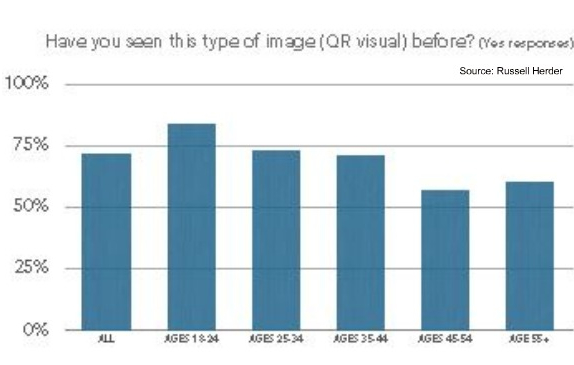
Thanks to the guys at Creating Result for blogging about research done about QR codes.
A while back I blogged about QR codes and the surge of the little suckers that were appearing like confetti on printed advertising. At time I couldn't see the point of the things, however, over time I have been converted - well changed my mind a bit.
This research appears to show that a high number of US consumers lack any understanding as to what QR codes are or how they work. It would seem that 72% of consumers say they have seen a QR code, but nearly 30% do not know what it is. In addition, nearly one in five consumers who regularly use the internet via mobile phone do not know what a QR code is. Consumers age 18-24 have the highest rate of having seen a QR code (more than 75%), while those age 25-34 and 35-44 both have seen a QR code at a rate almost the same as the overall average. Interestingly, a slightly higher percentage of consumers age 55 and up report having seen a QR code than those 45-54.
I reckon that with in the UK the over-50s the awareness of what a QR code is, how and why to read it, is less than 1%. Pure guesswork but few of my friends, many of whom are tech savvy wouldn't have a clue what to do with them. Dick Stroud
Friday, December 02, 2011
Bad news for trade promotions and print - celebrations for social media


Booz &Co has published some research called: "Shopper Marketing 4.0 - Building Scalable Playbooks That Drive Result".
Fortunately, some of the research's conclusions are easier to understand than the title. I was particularly taken by chart showing the change in CPG manufacturers' promotion mix. Even I can understand the message that is conveying. Dick Stroud
Gadgets that link directly to apps to improve wellness
In this week's FT there was an article about products that interface with apps to monitor various aspects of wellness. The three products reviewed were:
Jawbone UP (A combination of a wristband and iPhone® app that tracks your activity and sleep and "inspires you to move more, sleep better and eat smarter")
Fitbit widget (A "super sensitive 3-D motion sensor tracks your day down to details a pedometer can't catch, showing your exact steps taken, calories burned, and distance traveled")
BodyMedia FIT armband that (A system gives you "highly accurate information on activity, calories and sleep patterns").
I have used the company's own product descriptions. In my view this is going to be a big big market. I am not sure about the current generation of products but devices that directly interface with apps are going to be big business. I expect them to be popular with older consumers as aids to fight the ravages of ageing. Dick Stroud
Thursday, December 01, 2011
Goodbye home page - all change to mobile

McKinsey has published an article about what marketers think about working online and how they see things changing in the future. This chart has a very clear message that even I can get. Dick Stroud
Baby boomers key to brand segmentation - Errr
A couple of weeks ago Marketing Week had a throwaway comment about its coverage of Baby Boomers during December.
Yesterday the UK magazine had an article with the same title as this blog. Sounds interesting I thought. I was disappointed.
Yesterday the UK magazine had an article with the same title as this blog. Sounds interesting I thought. I was disappointed.
It looks as if the magazine had got hold of some research from a company called The Sound Research (interesting web site) about Boomers but it then failed to make any real mention about its conclusions. Instead there were a couple of odd and quotes like this:
WPP chief executive Sir Martin Sorrell tells Marketing Week: “Baby boomers are where the wealth and income is. I don’t know whether you can aim at both boomers and younger groups or whether you have to use more segmented and targeted strategies. But you ignore either at your peril.” Well of course you would be brain dead to ignore both groups of people.
Parents and grandparents combined with the 15to 24-year-old group make up about 50% of Skype’s customers. “Skype has typically had a really broad appeal across the age range,” says Skype marketer. About a fifth of its users are boomers. Interesting that Skype quantifies the number of Boomer users but so what?
The article features a case about New Balance trainers but for the hell of me I cannot see what point it is making.
I suspect there was more interesting stuff available to the journalist who either didn't want to or couldn't use it. Worth a quick scan but don't get too excited. Dick Stroud
Subscribe to:
Posts (Atom)