• Our Blog


About Dick Stroud

Dick Stroud is the founder of 20plus30, a marketing strategy consultancy specialising in the 50 plus market. He is the UK’s leading expert on using interactive channels to communicate with the over-50s market.

50-plus Marketing book
  • Contact

  • Email
  • Skype Name: dickstroud


50-Plus Marketing

News, views and opinions about the most powerful group of consumers - the 50-plus market.

Saturday, July 31, 2010

Why firms fail to leverage trends

This month’s HBR has an article titled: “Trends that could shake up your business.”

The commentary that interested me was that explaining why companies fail to leverage trends – like sticking their sand in sand and hoping the population ageing will go away.

The authors site three reasons.

  1. Ignoring trends that originate outside their markets – the “it doesn’t affect us” argument
  2. Respond to a trend in a superficial way – something I see every day of the week as companies launch countless ‘projects’ when they should be taking a roots and branch view of their strategy
  3. Waiting too long – this is the “there is always something more important to do” argument
These reasons are spot on and go a long way to explaining the idiotic lack of urgency that businesses have towards population ageing.

Good grief, if only demographics was as sexy as climate change we would have made so much more progress by now. When you think that the outcomes of demographic change are an order of magnitude more certain than those of climate change it makes you want to weep. Dick Stroud

Labels:

0 Comments Links to this post

Bookmark and Share

The amazing growth of Web video

Hopefully you don’t require any sign-on information to access these excellent podcast and presentation about the current and future state of the Web video market. The presentation is on SlideShare so you might need to sign-on/register. The highest uptake is still with younger age groups but there is a significant and growing use by the older age cohorts.


If you want to see how web video can be applied to the older market then visit InTwoFocus Dick Stroud

Labels: ,

0 Comments Links to this post

Bookmark and Share

Aging Markets Myopia

This article – full title is Markets Myopia - Why Companies Must Change Their Frame of Reference About Baby Boomer & Senior Markets – is very thoughtful and well worth reading.

My only criticism is that whilst it mentions physiological ageing it provides no guidance about how companies should respond and ensure their customer service is synchronised to the changing physical demands of older consumers.

Having said that - it’s good. Dick Stroud

Labels: ,

0 Comments Links to this post

Bookmark and Share

Why can't we be parted from our mobile - young and old

This article in Business Week makes a stab at identifying the human behaviours that make using mobiles - especially the ones that are stuffed full of apps – so appealing.

The reasons seem sensible and whilst you could say they are common sense they do provide a foundation for thinking about your mobile strategy. As far as I can see these reasons are pretty much age neutral.

  • We are in love with instant gratification. Mobiles enable us to exercise this desire 24X7.
  • We like filling time vs. killing time. We create mobile experiences in four- to 10-minute increments. Give us a few minutes and we want progress, info, answers, and closure.
  • We crave superhero powers. Our mobile phones allow us to interact in multiple places at the same time. A smartphone packed with apps makes us feel powerful.
  • Our instincts are to modify, adapt, hack, and create. Give people a tool, especially a technology or digital tool or channel, and they use it to achieve their goals in ways you never imagined. Who would think you could create 200,000 + apps for the iPhone.
  • We think of our mobile device as our "No. 1 recovery tool," and we never leave home without it. Why? It is a lifeline. Our phones are the first thing we reach for when we're away from home or the office and a problem comes up.
Find ways of satisfying these desires and you are in the money. Dick Stroud

Labels:

0 Comments Links to this post

Bookmark and Share

Behavioural targetting explained in 7 mins


Behavioural targeting is one of those subjects that most people have heard about and hopefully most marketers have a good idea how it works.

Just in case you want to polish-up your knowledge of the subject, have a look this beautifully made video - taken from the Wall Street Journal Web site.

The subject is not specific to older consumers but keeping track of them is just (if not more) important than any other group. Dick Stroud

Labels:

0 Comments Links to this post

Bookmark and Share

Thursday, July 29, 2010

50 years old is a tad young

About 30 miles away from where I live is a place called Southampton. When I read in the local press that it was going to provide an “action-packed programme of activities for this year’s Over-50s Festival” it naturally caught my attention.

The articl said that the “festival aims to give the city’s older generations the chance to get active and try something new this summer like t’ai chi, pottery, golf and pizza-making lessons, music, behind-the-scenes tours, boat trips and various cultural city tours – it will culminated with the Over-50s Festival ball at the Guildhall.”

A couple of other appeared in today’s news. First, the abandonment of the compulsory retirement age at 65 and also the revelation the number of HIV cases in the over-50s had doubled.

I found difficult to get my head around the idea that we have a festival for people who have at least another 15 years of work – probably more and who are clearly find lots to do with their spare time.

The serious point to these muses is that the Southampton event is really (I guess) aimed at the over 60s – probably the over-70s. Even though the marketing world attaches the label of ‘old’ at, or about the age of 50, this is not something recognised by the individual.

Just a free bit of advice to Southampton Council – next year change the name. Dick Stroud

Labels:

0 Comments Links to this post

Bookmark and Share

How the recession is changing shopping habits – store brands are on the march and will keep marching

This podcast from Deloitte Insight’s group is worth 18 minutes of your life. The message for CPG companies is not one they will want to hear. The recession (and it is only just beginning) is accelerating the acceptability of store brands. What started as a short term change in buying looks like it is getting cemented into the consumer's buying behaviour.

Deloitte has segmented consumer behaviour and come up with four distinct types of behaviours. The podcast is full of facts and really worth a listen.

What is fascinating is that there is one question on the Deloitte web page containing this podcast.

Question: "Out of the four groups it would be interesting to know if certain ages seemed to be grouped together."

Answer: "In our segmentation model that looked at attitudes and behaviours, we found that age, while important, is not a defining characteristic of the changed consumer in the recession."

Now isn’t that interesting? Dick Stroud

Labels:

0 Comments Links to this post

Bookmark and Share

Honda ranks highest among manufacturer websites in satisfying new-vehicle shoppers


Yes,yes…a research conclusion that I totally agree with.

When you consult and write about a subject it is very tempting to extrapolate the universe of the market from your own experiences. The fact that I like something or not, or indeed the fact that the people I know have certain preferences, doesn’t mean that we are any more than a tiny niche in a large group of consumers.

So it is brilliant that when you come to a conclusion you have it validated by the industry leader in the market sector.

I have been looking to buy a new car. This means I have spent, what seems like a lifetime, plodding through car manufacturer’s web sites. Some, most, are not good. Sure they are beautifully constructed but from the point of view of helping me to make a decision about purchasing a car they get a low score.

Honda stood out as a really well thought out web site. It did what a web site should do and anticipates what I wanted and then provided me with a simple way of achieving the outcome.

I didn’t buy a Honda but that was for a host of other reasons. The web site certainly was a big, big plus in making me favour the brand.

The crux of the issue is very well expressed in this press release from J. D. Powers.

Auto manufacturer websites that focus primarily on brand image promotion and interesting design features rather than usability may be hindering vehicle shoppers in their search for information.

Websites that maintain focus on usability, along with branding and design features, are the most successful in satisfying vehicle shoppers. For example, two high performing sites, Honda and Kia, each focus on usability and allow shoppers to access information quickly and easily. As a result, both Honda and Kia perform well in each of the four measures examined in the study: speed, appearance, navigation and information/content.

In contrast, some of the lowest-ranking websites use an edgy, brand-centric design that put marketing goals ahead of meeting shopper needs. As a result, they perform particularly poorly in the appearance measure. Certain design elements on these sites hinder speed, ease of navigation and user access to information and content. For example, some websites feature links to streaming music and options for selecting the website background scheme, which distract users from vehicle shopping. Other websites deviate from traditional pull-down menus in an effort to incorporate brand logos into the site design, which forces shoppers to learn an entirely new navigation scheme.

We are not talking about having to make the site boring but making it do what the consumer wants not to indulge the interests and prejudices of the web design team.

Remember that 50% (appox) of new cars are purchased by the 50-plus. Remember there are not that many 50-plus web designers. Dick Stroud

Labels:

0 Comments Links to this post

Bookmark and Share

Tuesday, July 27, 2010

Thoughtful article about Nielsen's conversion to the 50-plus

A week or so ago I wrote about the conversion of Nielsen to appreciating the marketing value of the 50-plus.

There was nothing new in what the research company was saying but the message gets a lot more authority when it said by an organisation like Nielsen than Dick Stroud.

There has been a lot of discussion about the article – the great majority in support with a fair share of “I told you so” comments.

Although this blog post is a tad ‘wordy’ it brings together not just the marketing common sense of age neutrality but also the economic conditions that are favouring the older consumer. Dick Stroud

Labels: ,

0 Comments Links to this post

Bookmark and Share

Monday, July 26, 2010

Another whining hatchet job on Baby Boomers

The New Statesman reviews a new book about Baby Boomers and what a dreadful bunch of people they are.

If you can imagine one thing worse than a bitchy, one sided, ill-informed commentary on the subject just think what it is like when this comes from a lefty with a massive chip on his shoulder.

Even the New Statesman thinks it is a bit of bummer but probably worth discussing if it tweaks the nose of the reviewer’s parents. Dick Stroud

Labels:

0 Comments Links to this post

Bookmark and Share

Sunday, July 25, 2010

Older consumers are driving the uptake of eBooks and eBook readers

Today's Telegraph has an article about eBooks  that compares the main vendors. Not surprisingly it comes down in favour of the iPad.

There is a quote in the article that 70% of Kindle purchasers are 40+. I thought it was high but not as high as that. The source of the figure seems to be this blog.

Who am I to argue. Dick Stroud

Labels:

0 Comments Links to this post

Bookmark and Share

Silver Surfer Today


This is a new site to me.

Lots of ads but not a great deal of content.


This site has nothing to do with the UK's Silver Surfer Day campaign. Dick Stroud

Labels:

0 Comments Links to this post

Bookmark and Share

Older consumers go online in Germany

An increasing number of older German consumers regularly use the Internet.

Accordign to TNS 96% of 14–29 year olds and 87% of 30–49 year olds regularly use the Web. This falls to 72% for people aged between 50 and 59 years old and 54% for those in their sixties.

Penetration reached just 23% for those in their seventies, although this was an improvement of 4.4% on 2009.

One noticeable trend is that more men than women log on to the web across all age groups. This gap was in single digits for 14–49 year olds, but rose to 22% for the over-60s and over-70s. Dick Stroud

Labels: ,

0 Comments Links to this post

Bookmark and Share

Same old question - same (ish) answers

Campaign - the UK mag for the advertising industry - periodically asks the question  - what about the oldies and each time comes to the same (ish) answer.

Yes, it is an important market. Yes, it should get more attention. Yes, things are about to change.

I wonder what the storyline will be in 2011? You will need to click on the image to read. Dick Stroud

Labels:

0 Comments Links to this post

Bookmark and Share

The pace of fragmentation of the UK is increasing

I hate averages. Averages tell us nothing.

The BMJ has just published a paper that looks at the inequalities in premature mortality in the UK over the period 1921 to 2007.

Bottom line conclusion is that the difference between the ‘haves’ (money, good lifestyle etc) and the ‘have nots’ (poor, bad lifestyle etc) is increasing.

As you can see, the gap in life expectancy at birth for 1999-2008 between the local authority with the highest life expectancy and the local authority with the lowest life expectancy has been increasing. The gap is the widest it has been since 1991.

OK, OK, all interesting stuff but what has this got to do with marketing. Well, if these conclusions are combined them with the results of the IFS wealth study you see importance (to marketers) of segmenting the UK into rich and poor. Trying to appeal to the ‘average’ will get you nowhere. Dick Stroud

Labels:

0 Comments Links to this post

Bookmark and Share

The older we get the better we were


Thanks to Janet Kiddle for telling me about this quote. I reckon it would make a great new line in my e-mail signature. Dick Stroud

0 Comments Links to this post

Bookmark and Share

Saturday, July 24, 2010

Online Banking the mix of age and education


This research from Deutsche Bank illustrates how the dynamics of age and education affect the uptake of online services – in this case the use of online banking.

As the second images shows, once an older person is using the internet then they are just as likely to use online financial services as their sons, daughters and grandchildren.

So the next time somebody asks you do older people use the Internet tell them: “That there is no simple answer and it all depends?” Dick Stroud

Labels: , ,

0 Comments Links to this post

Bookmark and Share

Friday, July 23, 2010

Aviva car insurance ad


This ad was first released this time last year.

If the objective is that I remember that Aviva sells car insurance and is not on comparison web sites then I guess it worked, however, I am not sure if this is worth annoying me with the negative portrayal. Tough call. As I always say to my clients -  be careful, very careful, of using humour when targeting the older person. Dick Stroud

Labels: ,

0 Comments Links to this post

Bookmark and Share

Thursday, July 22, 2010

Power of Word of Mouth (WOM)

An article in the Creating Results blog has some interesting stats about the effectiveness of referrals in the Health, Travel and Financial Services Industries

  • 50% of the 17 million adults who found a new primary care physician in the past year relied on recommendations from friends and relatives. More than 25% used such recommendations as their only information source.
  • At AAHSA in 2008, a presenter shared statistics from Shouldice Hospital which counted 49% of new patients as referrals from past patients.=
  • 34% of UK vacationers told consumer research group Mintel that they chose their destination on the basis of a face-to-face recommendation. Another 27% used online word of mouth sources such as user reviews.
The power of WOM was also illustrated by the research from Meredith’s Better Homes and Gardens reader panel that I blogged about in June.

This form of product promotion/product endorsement is not something that should be an after-thought to a marketing campaign but an integral part of it. Dick Stroud

Labels:

1 Comments Links to this post

Bookmark and Share

Wednesday, July 21, 2010

MetLife revisits the results of a previous study


Back in Jan 2009 Metlife published a study called “Discovering what Matters (Balancing Money, Medicine, and Meaning)."

At the time I wrote a blog posting about the study and wondered what impact the recession would have on the segmentation model that the finance company had developed..


Well Metlife has gone and revisited the subject and tried to answer some of these questions.

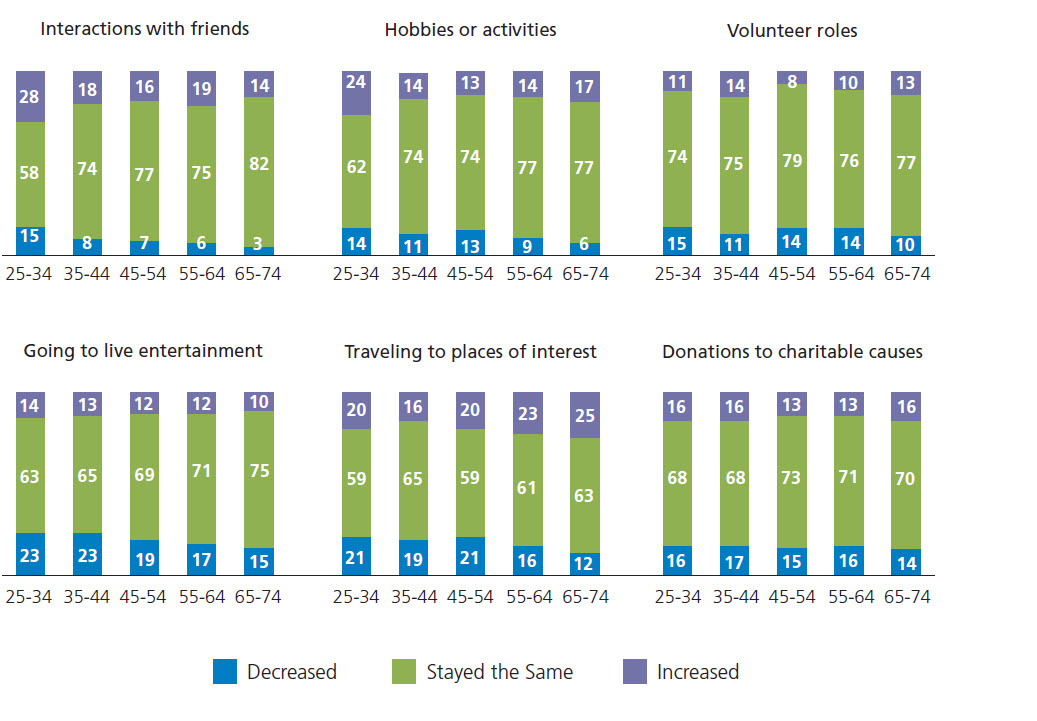
This chart is taken from the new study and shows the difference in response, between the two studies, analysed by age.

Other than interaction with friends I don’t think there is a hell of a lot that you can take from this research. Maybe I am missing some gems of insight, but a few percentage points here and there (you need to work out the net change to getting any real feel for what is happening) isn’t enough to make me think that much has happened - although I am sure it has. Dick Stroud

Labels:

0 Comments Links to this post

Bookmark and Share

Tuesday, July 20, 2010

Yet more proof about the importance of Web video

Using Web video as a means of communicating with visitors to sites – especially if they are of the older variety – is a no-brainer.

The Retail sector certainly seems to think so according to this eMarketer report.


Surveys of Fortune 500 companies have indicated a broad-scale increase in the use of video for marketing purposes. Video has gone from being a luxury to a near necessity.


Want to know how best to use video for the older consumer? Look no further than InTwoFocus. Dick Stroud.

Labels: ,

0 Comments Links to this post

Bookmark and Share

EBooks overtake paper on Amazon

The U.S. Kindle Store now has more than 630,000 books. Over 1.8 million free, out-of-copyright, pre-1923 books are also available to read on Kindle.

This press release from Amazon (US) tells that over the past three months, for every 100 hardcover books Amazon.com has sold, it has sold 143 Kindle books. Amazing.

Over the past month, for every 100 hardcover books Amazon.com has sold, it has sold 180 Kindle books. This is across Amazon.com's entire U.S. book business and includes sales of hardcover books where there is no Kindle edition. Free Kindle books are excluded and if included would make the number even higher.

Another interesting fact - Amazon sold more than three times as many Kindle books in the first half of 2010 as in the first half of 2009.

Don’t forget that the Kindle is very popular with the 50-plus.

No doubt about – digital media is on a roll. Dick Stroud

Labels:

0 Comments Links to this post

Bookmark and Share

Entrepreneurship: the New Mid-Life Crisis?

I have been banging-on for ages about the terrific opportunities for companies wanting to exploit the surge of older people who, out of necessity or desire, are starting their own companies.

If anybody needs any more persuading then have a look at what is going on in the US.

Kauffman is an organisation that seems to know a lot about the entrepreneurism and this is what it has to say on the matter.

Over the past decade or so, the highest rate of entrepreneurial activity belongs to the 55-64 age group. The 20-34 age bracket, meanwhile, which we usually identify with swashbuckling and risk-taking youth (think Facebook and Google), has the lowest rate. Perhaps most surprising, this disparity occurred during the eleven years surrounding the dot-com boom—when the young entrepreneurial upstart became a
cultural icon.

In every single year from 1996 to 2007, Americans between the ages of 55 and
64 had a higher rate of entrepreneurial activity than those aged 20-34.

For the entire period, the 55-64 group averaged a rate of entrepreneurial activity
roughly one-third larger than their youngest counterparts with these trends likely to persist.

If you provide any of the services associated with starting or extending a business then you have a ready-made market. Dick Stroud

Labels:

0 Comments Links to this post

Bookmark and Share

Baby boomers plan to travel despite financial concerns

AARP has an article on its Global Network about the continuing intention and capability of the 50-plus to free up their credit card and use it to travel.

Last weekend I was staying in a Central London hotel. I looked around me at breakfast and estimated that 80% of the dinners were 60-plus.

Well done Accor Hotels for targetting and attracting this group of older consumers. Dick Stroud

Labels:

0 Comments Links to this post

Bookmark and Share

Nielsen sees the light of age neutrality

I have noticed that over time that Nielsen, the US research company, is reporting in more positive terms about the business value of the older consumer.

This article from the company’s Web site is the most positive I have read to date. The following is a quote:

“Boomers should be as desirable for marketers as Millennials and Gen-Xers for years to come; they are the largest single group of consumers, and a valuable target audience. As the U.S. continues to age, reaching this group will continue to be critical for advertisers,” said Pat McDonough, Senior Vice President, Insights, Analysis and Policy at the Nielsen Company.
Consider these Nielsen facts about Boomers:
•  Dominate 1,023 out of 1,083 consumer packaged goods categories
•  Watch the most video: 9:34 hours per day
•  Comprise 1/3 of all TV viewers, online users, social media users and Twitter users
•  Time shift TV more than 18-24s (2:32 vs. 1:32)
•  Are significantly more likely to own a DVD player
•  More likely to have broadband Internet access at home
The article also publishes a comparison about the most popular web sites for the 50-plus and their kids. Notice the difference, or more accurately the lack of it? It is called age neutrality.

The next time some dimwit asks me the question: “what web sites do older people use” I will stuff this table under their nose.

Advertising Age has picked up and discussed this article. Worth reading both its take on things and the comments. Dick Stroud

Labels:

0 Comments Links to this post

Bookmark and Share

Monday, July 19, 2010

Landmark report about the impact of age and education on the distribution of wealth

“What does the distribution of wealth tell us about future retirement resources?”

This report was produced by the IFS for the DWP. It is a well researched document and provides a valuable insight into the ownership of wealth in the UK. It is a long report, 90 pages, stuffed full of data.

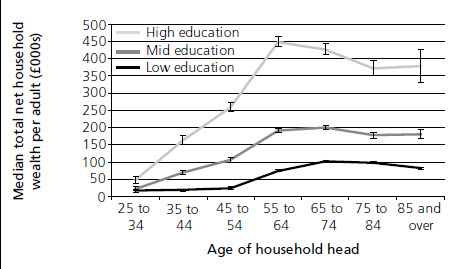
As an example I have showed two of the charts that illustrate the huge difference in the wealth holding of the UK population.

The analysts have done an excellent job trying to quantify the impact of the recession on the wealth holdings by the age and education of the person. Just look at the difference between the p25 and p75 gross wealth for the 55-64 year olds.


I thought this was an interesting quote and comes to a completely opposite conclusion to what I would have thought.

On average, we estimate that most households will have lost only a small fraction of their gross wealth. However, the proportion of net wealth lost is likely to have been higher for younger households – this is because their gross housing wealth (which will be affected by house price changes) tends to be largely matched by mortgage debt (the value of which would remain the same even if house prices fell) and thus their net wealth position tends to be more exposed to house price falls

You have to be careful with the definition of "low education" that is defined as having no educational or vocational qualifications. Remember that a lot of older people left school at 15, some at 14, but I would bet that their reading and numerical capability is a lot better than many young people who are defined as having a mid eduction.

A must download report. Dick Stroud

Labels: ,

0 Comments Links to this post

Bookmark and Share

Sunday, July 18, 2010

This is what the BBC had to say about my chums at BeGrand

http://news.bbc.co.uk/1/hi/programmes/click_online/8821430.stm


It was great to see that the BBC had featured the BeGrand web site in its Click online programme.

I have done some work with the marketing people at BeGrand who have created a lot of good content on a limited budget. I would think that getting featured by the BBC will have been great for their visitor traffic. Dick Stroud

Labels:

0 Comments Links to this post

Bookmark and Share

The basics of Web video


I have been a long time advocate of using Web video as a medium to communicate with older consumers. I even have my own company (InTwoFocus) that specialises in creating these types of videos.

I thought this was an interesting and amusing set of tips about selecting the ‘style’ of the video. As you would guess the document makes good use of video examples. This is my favourite. Dick Stroud

Labels:

0 Comments Links to this post

Bookmark and Share

Thursday, July 15, 2010

Britain’s debt: The untold story

Yet more doom and gloom about the state of the UK finances.

The article in the Independent has most of the nuggets of information. For those of you who want the gory details then you can download the full report from the ONS.

If you can put to one side the grim implications of the stats and read the detail you come to the conclusion that the one group of people who will continue to do pretty well in Austerity Britain is the Charmed Generation. That wealthy 20% of the 50-plus age group.

That does assume that inflation remains at relatively low levels. Dick Stroud

Labels:

0 Comments Links to this post

Bookmark and Share

Impact of ageing on the Tourism Industry

The Wharton Knowledge Centre has an article that takes a view of the impact of ageing on the Tourism Industry.

I thought this was an interesting quote from a senior manager with a Spanish hotel chain

"Changes in the population and the way it is aging are transforming the tourism industry, For example, Spanish society has evolved into two sorts of customers: those who have a lot of money but little time to travel, and those who have less money but more time to travel. The right approach to reach both of these market niches is product segmentation.”

This hotel company is working with various tour operators to prepare specific products that target the older segment of travellers -- couples in their fifties and sixties, widows and others.
I am glad that somebody is responding to the older market. Dick Stroud

Labels: ,

0 Comments Links to this post

Bookmark and Share

Battle of the bulge


This chart in the Economist says it all.

In a hundred years the shape (age profile) of Europe will have totally changed. Dick Stroud

Labels:

0 Comments Links to this post

Bookmark and Share

Build an app before you drink your first coffee


Google's new App Inventor is a tool for creating mobile apps for Android devices that doesn’t assume you know anything about programming or the technology of smartphones. That means it is something I and a zillion other people could use.

This is the face of application development. Take a good look and enjoy.

If you want a more detailed explanation about what is going on have a look at this video.

What I find so exciting is the way that tools like this will spur new app creation for niche markets. I can just see a lot of Boomers out there using it to create oldies' specific applications. Now what we need is an equivalent for the iPhone. Dick Stroud

Labels:

0 Comments Links to this post

Bookmark and Share

AgeWave Australia enewsletter

This e-newsletter arrived in my inbox this morning. Whoever sent it to me - thanks.

The 50-plus market in Australia has always fascinated me. This newsletter contains some interesting stuff about the local market and the global scene.

One item in particular captured my attention. Since 2007 I have been very interested in the Gay, Grey market. This is a wealthy segment of the market that is overlooked by marketers,

The newsletter has some interesting content about what is happening in Australia and in particular the opportunities for providing care services for gay people.

Well worth reading. Dick Stroud

Labels:

0 Comments Links to this post

Bookmark and Share

Most new Internet user are 50-plus

According to UKOM, an organisation “Powered by Nielsen" the size of the UK Internet audience grew by 5% from 36.9 million people in May 2009 to 38.8 million people in May 2010. Of these 1.9 million new Britons using the Internet, 1.0 million (53%) were age 50 or older.

Men were responsible for most of this growth, accounting for 722,000 new users.

I would love to see the methodology that was used to reach this conclusion. I wonder what the definition is of a 'user'.

I can understand how the conclusions were reach for the Web sites audiences, although I would like to know the confidence level for the findings. How the hell Flixxy got into the list I don’t know. Dick Stroud

Labels: ,

0 Comments Links to this post

Bookmark and Share

Why the interest in the “quality of death”


The Economist Intelligence Unit was commissioned by the Lien Foundation to research the issues associated with dying and how the quality of death varies between countries.

Much to my astonishment the UK is seen as being the best place to die!

The web site that accompanies the research must be one of the strangest I have seen.

This is a major research document. The EIU doesn’t do flim-flam research.

I was left wondering why so much time has been spent researching the subject. It did make me think that there are lots of business opportunities associated with end-of-life that our squeamishness stops us pursuing. Dick Stroud

Labels:

0 Comments Links to this post

Bookmark and Share

Tuesday, July 13, 2010

Facebook is so 2009


E-Marketer contains research suggesting that increasing numbers of teens are deserting Facebook. There is a long list of reasons why this is happening and that fact their parents are snooping about comes well down the list.

Good old fashioned boredom is the number one reason. Dick Stroud

Labels:

0 Comments Links to this post

Bookmark and Share

New iPhone 4 ad


Apple has launched a series of ads that cover the age spectrum from child to grandparent. Simple and effective. Dick Stroud

Labels:

0 Comments Links to this post

Bookmark and Share

Monday, July 12, 2010

Martha Lane Fox plan to get all Britons online


The UK’s digital champion (Martha Lane Fox) has announced plans to get everybody of working age in Britain online by the end of the current Parliament.

There are currently 10 million Britons who are not using the Internet and a lot of these people are 65+.

She says that no-one should reach retirement age without gaining experience of using the Web. That is one hell of a target to set.

You can download the complete report from here. For collectors of factlets about the state of “online-UK” it is full of facts and figures. Dick Stroud

Labels: ,

0 Comments Links to this post

Bookmark and Share

Where Brits can go when they retire and what services they require

I received an e-mail from the publisher of The International Retirement Directory asking if it was OK if he sent me a copy of the book. Yep, I said, send me a copy.

I have a large pile of unread books so I thought that one more would not make a difference.

I wish I had refused the offer since I have spent too much time reading about all of the nice places I could be spending a restful retirement, with good weather, half the cost of living of the UK and no austerity budgets.

It makes you think. Why on earth would you want to retire in the UK? OK, I know there are lots of good reasons associated with friends and family and familiar surroundings etc etc. However, there are a hell of lot of good reasons why getting the hell out of the country to one of these far away paradises sound mighty attractive.

As you can see I like the publication.

The book quotes the Foreign and Commonwealth Office as saying that 38% of Brits, over the age of 55 are considering relocating overseas in the next five years. I suspect that number has gone up a bit in the past 12 months and will continue to rise. I would think this directory has a fast growing market as Brits seek places to go away from austerity Europe. Dick Stroud

Labels:

0 Comments Links to this post

Bookmark and Share

Sunday, July 11, 2010

Kids, stop moaning and just leave the baby-boomers alone

This is the title of Catherine Bennett’s article in today’s Observer.

I have commented a number of times about the infantile warblings of the anti-boomer brigade so I will not bother to do so again. This is not a bad article and makes all of the right points. The sad and disturbing thing is the associated comments.

Clearly, there are some really sad people out there who blame all of their misfortunes onto somebody else, preferably a wicked Conservative politician. I guess the world has always had its inadequates? It is one of the downsides of the Internet that enables these people to promote their ill-conceived opinions.

Most older people are acutely aware of the hard time being had by young people and doing their best to ease their pain. Most young people I meet are acutely aware of their misfortune of being born after a period of financial mismanagement of the European economies, on an unbelievable scale, by a bunch of incompetent politicians. Yes Mr Brown, I mean you!

It has nothing to do with age and everything to do with the frailty and appalling lack of ability of the governing class.

Dick Stroud

Labels:

0 Comments Links to this post

Bookmark and Share

Is the "empty nest" household just a dream?

A survey by VibrantNation.com  suggests that while US Boomers typically would be dealing with “Empty Nest” syndrome as their children leave home they are in fact running multi-generational boarding houses.

Nearly 2/3 of Boomer women respondents reported that one or more of their adult children have returned home to live and of those adult children, nearly half have brought one or more of their own children along too. And that’s on top of the 13% of Boomer women who report that their parents or in-laws are living with them as well.


The founder of VibrantNation.com said: “The Recession is making the 'Empty Nest' a historical relic, at least for Boomers and that our research suggests that they are footing the bill for their children, grandchildren and even parents who have moved into their homes and are now assuming multi-generational housing responsibilities that we probably haven’t seen since the Great Depression.”

According to the Vibrant Nation survey :
  • 63% have an adult child living with them now (only 41% report ever having returned home to live as adults themselves) and most expect their adult child(ren) to remain with them for more than one year.
  • 27% have grandchildren living under the same roof
  • 13% have parents or in-laws living with them as well

70% blame the economy as the reason for this outcome.

Such a massive change in the structure of households must affect the type and quantity of products being purchased. I wonder how many companies have come to terms with this re-arrangement of their markets? Dick Stroud

Labels:

0 Comments Links to this post

Bookmark and Share

Old usability problems will not go away

My hero Mr Nielsen reckons that 80% of the usability findings from the 1990s are remains in force.

He thinks that only 10% of the original usability issues have resolved because of improved technology.

All this good Web 2.0 technology hasn’t addressed the real issues that cause users to get lost, misinterpret sites, or be annoyed.

I reckon that some sites have gone backward (yes that is you Tesco) and a lot of others seem to have forgotten lots of the basics – like giving the web user some visual feedback of where they are in the site.
This really is a bad indictment of Web developers. Dick Stroud

Labels:

0 Comments Links to this post

Bookmark and Share

What teens think when parents join Facebook

I have often wondered what the reaction of my friends children is to the arrival of mum and dad on their Facebook page. I always guessed it would be shock horror.


eMarketer estimates that 74.9% of teen Internet users were regular social network users in 2009, rising to 78.2% in 2010. By 2014, 85.7% of teen Internet users will use social networks.

With the youth audience at such high levels of social network penetration, adults have fueled the bulk of growth on sites like Facebook in 2009 and 2010.

How young people perceive the influx of older users depends on their age, according this survey in E-Marketer, conducted in May 2010.

A majority of younger teens reportedly hate it or feel annoyed or nervous when their parents are on the same social network, but among more mature 18- and 19-year-olds that percentage fell to 27%.

I am amazed they are so tolerant. Dick Stroud

Labels:

0 Comments Links to this post

Bookmark and Share

Saturday, July 10, 2010

Inflation is not age neutral


There is a lot more to the rate of inflation than can be expressed by a single figure. It is a bit like reading about the increase in life expectancy – it all depends which group in society you are talking about.

The Alliance Trust Research Centre publishes a detailed analysis of the rate of inflation split by different age groups. (The research is not online so I have not been able to give a link). These are the main results:
  • For the eighth consecutive month, it is the 50-64 year olds who are facing the highest rate of inflation, at 4.6%. This is 35% higher than the official headline rate of 3.4%
  • All five age groups saw a decrease in inflation during May. The biggest beneficiaries were the 65-74 year olds, whose inflation rate has fallen from 4.5% to 4.0%, helped largely by a sharp decline in food price inflation
  • The over 75s experienced a decrease of 0.3%, which leaves the rate of inflation facing this age group at just 3.3%, the lowest of all age groups in the study, and lower than the official headline rate
  • The rate of inflation facing the under 30s has fallen to 4.1%, helped by ongoing deflation in clothing and audio-visual products

The reason for the differences by age is accounted by the different consumption habits. The table shows the difference in purchasing some of the main items of expenditure. Be careful with this data since you also need to take into account the absolute level of expenditure of each of the age groups. Dick Stroud

Labels: ,

0 Comments Links to this post

Bookmark and Share

A nice sales approach for weight loss

I get loads of PR releases telling me about all sorts of things that agencies think will interest the 50-plus. Most of the time they are long-winded and not relevant.

Today I received one from a US agency. Whilst I hope all of the readers of this blog are as thin as a whippet I thought it was worth publishing the e-mail since to my mind it is how an agency should contact a blogger. Very direct with a clear call to action.

Please consider the following topic for a contributed healthy lifestyle story. As obesity is a common problem for retirees, this information should be of interest to your readers. It would fit nicely among your fitness posts, particularly those involving weight loss methods and joining health clubs. I can provide a bylined article or coordinate interviews and background information.

STORY IDEA:

For many people, retirement means several things: a break from the daily grind, time to catch up with friends and family, relaxation and vacations. Retirement is also a time to focus on your often-neglected personal health. With more than two-thirds of American adults overweight or obese, weight loss is a common goal for most people.
The e-mail then gave a couple of paragraphs about the company and the founder. Short, clear and to the point.

I think older people at a life changing point like retirement is a good moment for a fitness/wellness company to target. Strange how few companies are adopting this strategy. Dick Stroud

Labels:

0 Comments Links to this post

Bookmark and Share

Vintage TV appoints a PR agency

Recently I wrote about the forthcoming launch of a new TV station (Vintage TV) targeting the 50-plus. This sort of thing doesn’t happen every day of the week so I thought it was worth keeping an eye on the project’s progress.

PR Week had a short release announcing that Braben had been appointed the company’s PR agency with a brief for a B2C and B2B campaigns to.

Educate potential advertisers, investors and consumers about the unique range of programming and presenters the channel will offer the over-50s demographic in the UK.
Celebrity management, developing social media and a full press office set up are also elements of the campaign Braben will provide.

I look forward to reading lots about the channel in the forthcoming months. Dick Stroud

Labels:

0 Comments Links to this post

Bookmark and Share

Friday, July 09, 2010

How the great recession has changed America


Pew has published a major research study about the impact of the recession on different parts and groups of Americans.

I was just interested to see the effect of the respondents age.

It is good to see that young people retain their youthful optimism, even though they appear to have had a harder time than their elders when it comes to employment.

Unfortunately, I think that the older age groups know something that their children don’t. Dick Stroud

Labels: , ,

0 Comments Links to this post

Bookmark and Share

Reader’s Digest UK reappears as an iPad App

Would you believe it? No sooner than the good old Readers Digest disappeared from print than it has re-emerged as an iPad app.

I have to say that it is not bad, but the new owners are setting themselves a really challenging task. The need to attract the types of people who want to read the content and style of the RD and who also have an iPad.

I appreciate the cost of distribution is far less but I am not convinced that the sums will stack-up. Still, if you are iPad users it is worth looking at this month’s edition – it’s Free. Dick Stroud

Labels:

0 Comments Links to this post

Bookmark and Share

Time spent using Facebook by age and income

The 2010 Morpace study surveyed an online panel of 1,000 American consumers and found, amongst other things, the results shown in the graphic.

I am amazed that there is so little difference between the time spent online between the different age groups. The time spent using Facebook doesn’t surprise me. I am also surprised at how small the difference is for the amount of time spent online by the different income groups.

I am dubious about these results. Dick Stroud

Labels: ,

0 Comments Links to this post

Bookmark and Share

Thursday, July 08, 2010

E-readers v Tablets

A marketing professor at Wharton reckoned that if he was given control of Kindle marketing his first move would be to differentiate the device from the iPad.

This is a nice way of expressing it: "Amazon has to get to the point where the iPad and Kindle don't show up in the same sentence." He went to say, "at this point I'd almost prefer to give it away as part of some Amazon premium reader program. It's only there to get people to buy stuff from Amazon.”

The article from Wharton came down strongly on the side that E-Readers don’t stand a chance if they go head-to-head with tablets.

As I have already written, there is not much to choose between the readability of using an e-reader and a tablet. The big difference is the multiple other applications under the cover of a tablet.

I don’t think I will be investing in a Kindle. Dick Stroud

Labels:

0 Comments Links to this post

Bookmark and Share

The elephant in the room has been replaced by a herd of woolly mammoths

I know that I have been “going on” about the perilous state of the European economies and why planning for the consequences should be the first, second and third priority for marketers.

I think that a lot of marketers are deluded and think that now the credit crunch initiated recession is out of the news that things will get better. This was just the first round, the main course is about to be served.

Yesterday I attended a conference about “Reducing the deficit and improving public services”. The speakers included senior members of the new government and a lot of well informed people who know about the reality of the austerity measures that are about to sweep through UK.

Francis Maude MP, the keynote speaker, announced that he intends to ask (I think tell is a more accurate word) the 20 biggest suppliers of services to government – from IT to custodial services to medical tests for benefit claimants –to cut their prices in order to help reduce the nation’s deficit.

He said: “he would be renegotiating with them across everything they do for the government to get costs down and will want to have something off their margins.”

Even a pessimist like me was shocked. As I left the conference, and looked at the smiling faces of crowds in Central London I wondered if they had any idea what is about the happen.

Please don’t take my word for it – have a read of these articles from Wharton and McKinsey .
Reading the Business Sections of the newspapers would be another good idea.

Sure there are going to be opportunities, lots of them, but continuing as normal is not one of the options.

As I have already written today, one of the biggest issues is going to be the disproportional way in which young people are going to be hit by the downturn.

Deciding which groups of consumers are going to be the least affected is a good place to start. Dick Stroud

Labels: ,

0 Comments Links to this post

Bookmark and Share

Young people are poor and it’s getting worse

Marketers have an aversion to studying and acting upon demographics and economics data.

The enormity of the shift in employment patterns (more accurately unemployment patterns) seems to escape the marketing world.

Look at these numbers from the US. Nearly 40% of 18-19 year olds are unemployed or not seeking work. If you can bear to look, see what is happening in Spain – youth unemployment is well over 40%. Just take a couple of minutes and read this front page article from the New York Times. Then ask yourself the question: “If this is true (which it is) why are we focusing so much of our marketing budget on this poor hapless group of consumers.”

Of course, things are not going too well for their parents or grandparents, but in the main they do have some financial fat that can maintain their spending. The young are unlikely to have any accumulated wealth that you can translate into income.

This is not rocket science. Dick Stroud

Labels: ,

0 Comments Links to this post

Bookmark and Share

Tuesday, July 06, 2010

Preparation for retirement

I have spoken with Mark Miller at a couple of conferences in Europe and the US.

After a great deal of hard work, Mark has completed his book “The Hard Times Guide to Retirement Security”.

The book details all of the items that you need to consider for that strange time we now call ‘retirement’.

A lot of the detail of the book is specific to the US but many of the generic items are just as relevant to the UK. Well done Mark – one hell of a lot of work.

The book is an excellent insight for marketers interested in the issues confronting older people as the move into the 'retirement' phase of their life. Dick Stroud

Labels:

0 Comments Links to this post

Bookmark and Share

The book v the Kindle v iBooks (iPad) - place your bets

Jakob Nielsen has been researching the reading speed and user experience for the Kindle and iPad. Both products that are proving surprising popular with the older demographic.

I don’t have a Kindle but have the Kindle2 software on my iPad and have tried reading books using both iBooks and the Kindle emulator. To be honest I didn’t think there was that much difference. This is what Mr Nielsen had to say.

People reading books on tablet devices have higher reading speeds than in the past, but they're still slower than reading print.

The iPad measured at 6.2% lower reading speed than the printed book, whereas the Kindle measured at 10.7% slower than print. However, the difference between the two devices was not statistically significant because of the data's fairly high variability.

Thus, the only fair conclusion is that we can't say for sure which device offers the fastest reading speed. In any case, the difference would be so small that it wouldn't be a reason to buy one over the other.

The iPad, Kindle, and the printed book all scored fairly high at 5.8, 5.7, and 5.6, respectively. The PC, however, scored an abysmal 3.6.

Most of the respondents disliked the weight of the iPad (I have to agree with that) and that the Kindle featured less-crisp gray-on-gray letters. People also disliked the lack of true pagination and preferred the way that iBooks indicated the amount of text left in a chapter.

Since the iPad and Kindle are in their first phase of development I reckon the response of the readers was very positive. Just think what it will be like when the devices are half the weight and have twice the screen resolution and when electronic books are 10% the price of the printed version. The tablet will be a no-brainer. It is not a matter of if but when the printed book becomes a luxury purchase. Dick Stroud

Labels:

0 Comments Links to this post

Bookmark and Share

Monday, July 05, 2010

Technologies that might take the pain our of getting old

Forbes has an article about some of the technologies that under development that are expected to help the elderly.

To be honest, I thought this was a bit of a re-hash of technologies that have been around in various stages of development for the past few years.

Exciting and interesting they might be but I wonder if they are really going to make that much difference.

If the care industry in the US is anything like that in the UK then most of it is operating with technology from the 1950s on ultra-tight budgets using minimum way staff.

Maybe some of this technology will help the affluent elderly but I doubt it if will do that much good to the great mass of people. I hope I am wrong. Dick Stroud

0 Comments Links to this post

Bookmark and Share

Smartphone and healthcare – a perfect match?

The company behind the Blackberry and India's Vodafone Essar announced the launch of a mobile health device meant to help medical professionals in detecting heart attacks.

The device will record cardiograms taken by paramedics and store them on a server that also contacts doctors' Blackberries on the Vodafone Essar wireless network. Doctors will also be able to use the server to access and assess patient information.

The “senior-friendly” Jitterbug phone is marketing similar health services to baby boomers in the U.S with its new LiveNurse service.

Portable computing + mobility + declining costs of devices and networks + an obvious set of healthcare applications should be perfect match. Dick Stroud

Labels:

0 Comments Links to this post

Bookmark and Share

Sunday, July 04, 2010

Is television advertising for old people?

The median age of prime-time television viewers (in the US) is nearing 51 years old.


In words of one syllable, this means that more than half of all prime-time viewers are outside of the advertiser's favourite demographic of 18-49. The medium that has long been synonymous with massive reach is quickly becoming the most efficient way to reach lots of old people! Dick Stroud

Labels:

0 Comments Links to this post

Bookmark and Share

RIAS deploys a regional multi-media brand campaign

Over 50s specialist insurance provider RIAS has launched a regional multi-media brand marketing campaign, across TV , radio, online, PR and regional events , targeting over 50s in the Central ITV region.

The RIAS 'Better With Age' campaign will run for an initial three month period from May, and is centred around a 30 second TV advert highlighting real life consumer stories of people who have all achieved something extraordinary since they turned 50 years old, as well as a new 30 second radio advert, both directing consumers to the micro site.

RIAS will also reinforce the advertising with a physical presence across the region, including being a sponsor at the BBC Gardeners’ World Live Show in June at the Birmingham NEC, as well as visiting a number of Wyevale Garden Centres to meet with over 50s consumers.

I have a lot of time for RIAS. They have stuck with their brand proposition and over the years made it increasingly more sophisticated. It is not the most exciting of brands but then nor is car insurance.

I wish them luck with their campaign. Dick Stroud

Labels:

0 Comments Links to this post

Bookmark and Share

AARP's insights into the iPad


This is a list of the ten things you need to know about iPad.

Not sure I agree with them all but it is not a bad list. The video is worth watching. A bit like spying into an open focus group.

I was struck by the techno literacy of the older people. A long way away from the stereotypes conjured up by the young lads in my other blog post about the iPad.

It will be fascinating to see the iPad’s sales demographics. I am still certain that the uptake by the older age group will surprise a lot of tech-pundits. Dick Stroud

Labels:

0 Comments Links to this post

Bookmark and Share

What is going on in your noodle (head)

Newsweek has an interesting article about cognitive ageing.

Much of it is based on a book by Timothy Salthouse called "Major Issues in Cognitive Aging". It sounds interesting enough to make me order the book.

It appears that cognitive ageing is a far more complex process than we might have first thought. There is a lot more to it than the simple analogy that our “processing speed” declines – a bit like car that has an engine that has done 200,000 miles - the older we get.

Once I have read the book I will return to this subject.Dick Stroud

Labels:

0 Comments Links to this post

Bookmark and Share

Web creep on steroids

Web creep is a common disease that afflicts all but the most disciplined Web sites.

Yahoo has a terrible dose of the disease - Google has remained remarkably free from affliction.

The most common symptoms of Web Creep is a progressive disregard for the person using the site that is replaced by the desire to try and squeeze as many links, images and bits of animation on the page as possible.

The first thing to go is the navigation structure that had a pristine logic at the site's birth and then decays, so that the site user has no idea where they are likely to find the links to satisfy their requirement.

One of the most common causes of the disease is lack of discipline to enforce access to the cherished home page real estate. Web designers give up trying to force the hot shot marketers from forcing their links onto the page. The result is muddle.

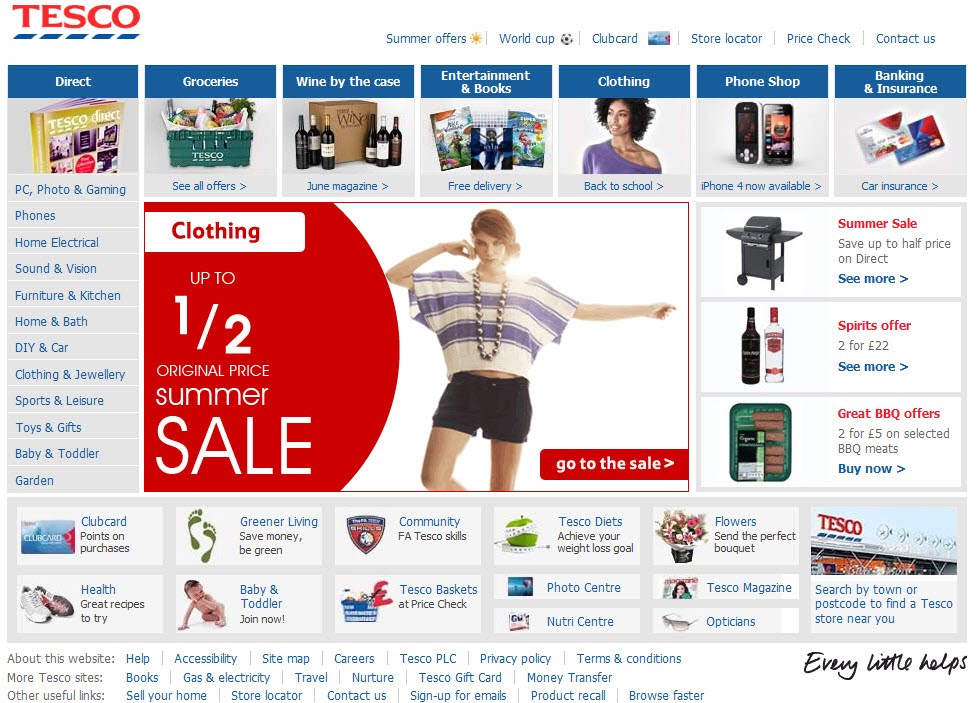
I haven't had a look at the Tesco site for some time and was amazed to see what a mess it has become. Come on guys, you are a terrific company. Sort it out.

Whilst young people might have the patience to fight their way through the multiple navigation options the same will not happen with the older consumer.

This is the way the site looked in 2008. To my mind it is much easier to use. I wonder what has happened in the past 24 months? Dick Stroud

Labels:

0 Comments Links to this post

Bookmark and Share

Reasons why you mum/mom wants an iPad - what the sons think


I wrote about this article when it was first published. I agreed with the conclusion but thought the rationale was somewhat banal and patronising.

I found this short video clip far more amusing as three hot shot tech sons give their views about the suitability of the iPad for their mums/moms.

I would love to hear their moms/mums views about their pride and joy’s views. Dick Stroud

Labels:

0 Comments Links to this post

Bookmark and Share

Saturday, July 03, 2010

Marketing is more than marketing coms

“Why don’t more companies target the older consumer”? I wish I had a dollar for every time somebody has asked me this question.

After this question comes the next observation: “I guess it is because most marketers are young.” No I say, I don’t think that is the main reason.

“Well what is”, is the next question.

I then say that it is because marketers are a conservative bunch and don’t like stepping away from their perception of ‘normal’ marketing. The other reason, that I rarely say, because the questioner might to get annoyed, is that most marketers don’t do much more than marketing communications.

A report from Forrester seems to come to about the same conclusions. If you want to pay $500 you can buy the document and read the details but the bottom line seems to be that Chief Marketing Officers should concentrate on influencing the strategic direction of their company and not just managing advertising.

The “Define Your Marketing Innovation Strategy” report says marketers are not taking advantage of the changes in consumer behaviour and the possibilities offered by new technology.

It warns that Marketing Directors must “redefine how their company will interact and engage with consumers and customers in the future” by adapting their marketing methods to accommodate future customer engagement methods. Sounds sensible to me.

According to the report, less than 30% of senior marketing people see themselves as agents of change, and do not consider innovation as an important part of their jobs. So if marketing is not going to lead innovative developments who will – the Finance Department? Methinks not. Dick Stroud

Labels:

0 Comments Links to this post

Bookmark and Share

Thursday, July 01, 2010

UK Web users are getting older


According to UKOM, almost a third of the online population is aged over 50, with 1m new people in that age group coming online in the year to May 2010. Men accounted for about 722,000 of those new older web surfers.

UKOM has kindly made available a PowerPoint presentation containing lost of its research findings.

A spokesman for the research company (that is part of Nielsen) reckons that the growth is not just due to saturation in younger demographics but is also driven by increased confidence in online security and the increase in Web sites targeting older users.

Health, travel, genealogy and cooking sites are among the most popular kinds of websites for the over-50s, Nielsen found after analysing the behaviour of its panel of 45,000 people.

The person from Nielsen also said: “The general consensus is this age group tend to have more disposable income and tend to be less fickle [than younger people]. “Advertisers are continually going after younger demographics but this group is very much overlooked in terms of their purchasing power.” Well I cannot disagree with that! Dick Stroud

Labels:

0 Comments Links to this post

Bookmark and Share